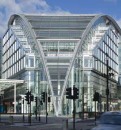
Controversy around 1 Silk Street, one of the City of London’s latest office proposals
Despite the number of skyscrapers going up in the City of London, few planning applications have generated as much controversy as the application for 1 Silk Street for a 21-storey, £450 million office block.
The site and proposals
Located next to the Barbican Estate, the proposals have highlighted the clash between residents and the City’s ongoing ambition to maintain its global economic competitiveness. The current building at 1 Silk Street is a 1980s office building and the current occupier is relocating. This has allowed Lipton Rogers Developments, on behalf of LaSalle Investment Management, to bring forward proposals to demolish the existing building and replace it with a large office-led scheme including new commercial floorspace, cultural and community uses at ground floor.
The scheme reflects another example of the City of London’s priority to deliver high-quality Grade A office space to attract global businesses. With many existing office buildings in the Square Mile now considered outdated in terms of environmental performance and workspace standards, redevelopment projects such as this are increasingly seen as necessary to support the City’s long-term competitiveness.
Controversy
Since the planning application was submitted in October 2025, the scheme has faced significant opposition, particularly from residents of the neighbouring Barbican Estate. More than 1,000 objections have been submitted on the planning portal, compared to 11 letters of support.
Despite that, there have been many objections from outside the local area, even addresses from abroad, the objectors’ arguments have remained consistent. Residents argue that the development would negatively affect daylight levels and overshadow nearby homes, while the proposed design will negatively affect the setting of the neighbouring Grade II listed Barbican Estate. Relevant heritage groups and campaigners have submitted objections with similar concerns about the scale and design of the proposals.
On top of this, it was discovered in February 2026 that two nesting peregrine falcons were spotted using the Barbican towers near 1 Silk Street. Under British wildlife protection laws, peregrine falcons receive the maximum level of safeguarding, making it a criminal offence to disturb them while breeding. As a result, this has forced the City of London Corporation to undertake further environmental assessments to confirm whether the birds are nesting before any construction can begin, adding more cost, delay and another reason to object to the proposals.
Revised proposals
In response to the feedback during the statutory consultation process, the developer has revised the proposals. This includes reducing the height and mass of the scheme, altering the design, introducing further privacy measures and amending the proposals for the dedicated cultural spaces.
An eight-page booklet was delivered to Barbican residents informing them of the revised scheme, however, the objections are still coming in and do not seem to be slowing down.
The application is currently undergoing another round of consultation on the revised proposals and is expected to be considered by the City of London’s Planning and Transportation Committee later this year. Until then, the application is definitely one to watch, as it asks a key question about what the City ultimately prioritises: protecting the amenity of its residents or maintaining its position as a globally competitive financial centre.

Strategic land and site promotion
“Chelgate gives a real insight into political thinking at all levels and all political persuasions, …

Energy and infrastructure
From new nuclear and unconventional gas to renewables, waste and airports, our team has worked …